In my continuing effort to attempt to build a highly detailed layout without doing all of the work :) the construction of Boggy Creek Bridge was contracted out to Darren French... he has not disapointed!
The following are some in progress shots... now to convince him to do the rest of the scenery....
Now is there anyone out there who wants to build me a hundred trees or so?
Cheers
Rob
Monday, February 14, 2011
Thursday, February 10, 2011
T3 and P class locos
Well I've been busy back at work the last few weeks and modelling has been quiet limitied, bits here and there... which are now coming together...
First is a sample of my next ready to run locomotive, the Series 3 T class. It will be cast and painted in China over the next few months and will be sold with a Kato NW2 mechanism. First though I have to paint samples and do the artwork for the printers, hence this sample. They colours aren't exactly right, it is more to get the overall feel and placement of artwork.
The model is cast in polyurethane, with brass roof and window surrounds, and I'm asking for wire hand rails to be fitted on the production versions. A VLINE version is also planned.
In addition I've had some orders for P class locos, shown below is a Freight Australia one. The model was assembled by Paul Welshe, painted by me (using a Tamiya spray pack) and decaled by John Smith (a recent convert to trains and N scale). John comes around most Thursdays for a modelling night, his wife and mine bead on another night... a real win win !
Gotta go now, hopefully will get a bit of modelling done over the weekend, 'aveagoodweekend!
First is a sample of my next ready to run locomotive, the Series 3 T class. It will be cast and painted in China over the next few months and will be sold with a Kato NW2 mechanism. First though I have to paint samples and do the artwork for the printers, hence this sample. They colours aren't exactly right, it is more to get the overall feel and placement of artwork.
The model is cast in polyurethane, with brass roof and window surrounds, and I'm asking for wire hand rails to be fitted on the production versions. A VLINE version is also planned.
In addition I've had some orders for P class locos, shown below is a Freight Australia one. The model was assembled by Paul Welshe, painted by me (using a Tamiya spray pack) and decaled by John Smith (a recent convert to trains and N scale). John comes around most Thursdays for a modelling night, his wife and mine bead on another night... a real win win !
Gotta go now, hopefully will get a bit of modelling done over the weekend, 'aveagoodweekend!
Saturday, January 1, 2011
Road over Rail Bridge part 1
Over the last three days I've been tackling one of the most challenging structures on Nowa Nowa, the road over rail bridge at the west end of the yard.
Originally it was a two trestle wooden structure. Sometime in the period 1978-1986 it was rebuilt into a concrete structure.
I have been thinking long and hard about which version to do. I prefer to model the 1984-1990 period with VR and VLINE... but I couldn't be sure exactly when the bridge was demolished (with possibly the departmental residences demolished in about the same time...). In the end I decided I liked wooden trestles too much :)
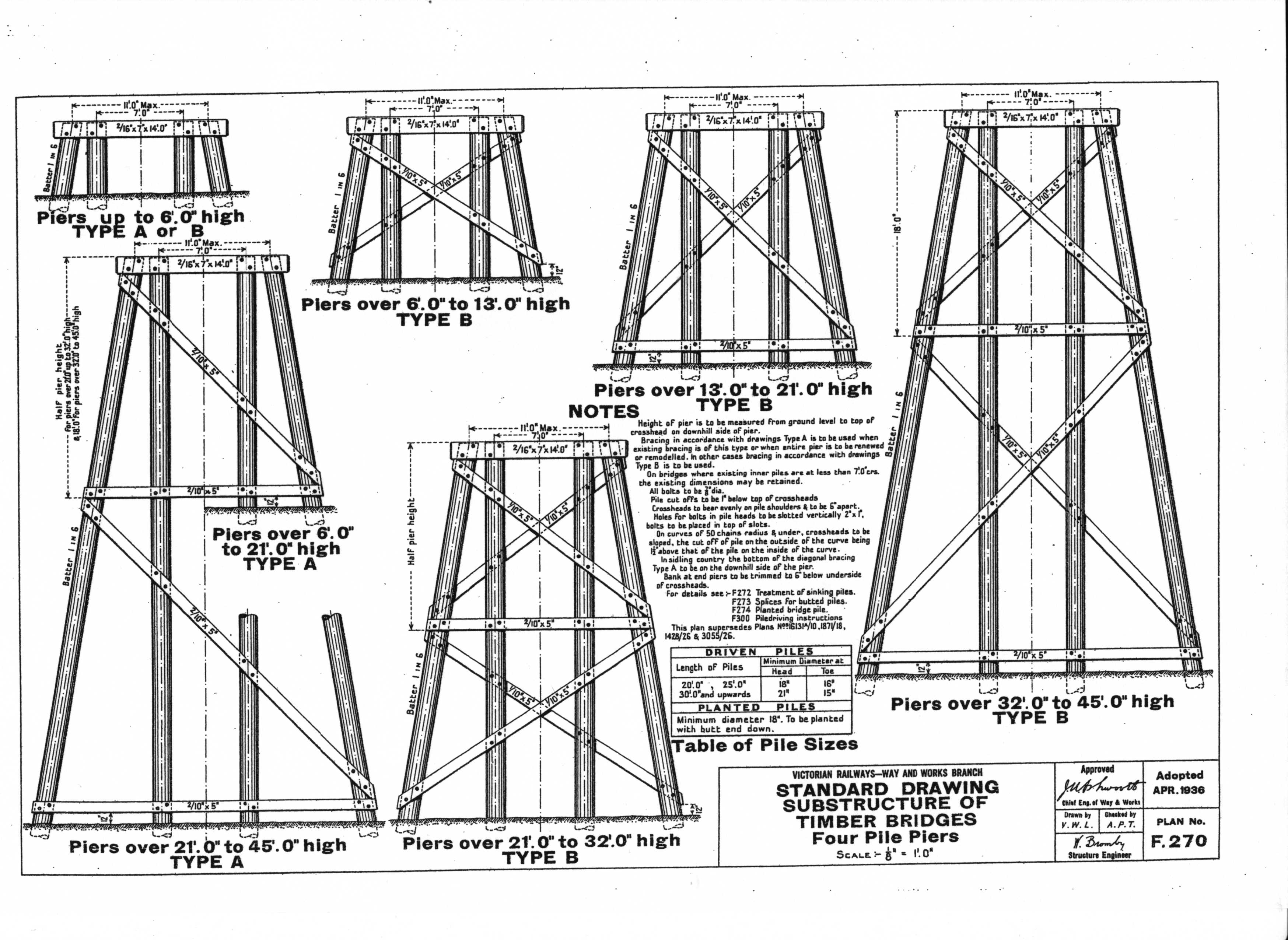
With such little photographic evidence it was hard to do the bridge... so I trawled through Mark Bau's excellent site http://www.victorianrailways.net/ in the infrastructure section and came across this plan:
http://www.victorianrailways.net/infastuct/aa_fseries/f270.jpg
I figured that I could adapt it so I drew it out in Corel Draw to scale, and found that the "Piers over 13' and under 21" was spot on!
Here is a JPG of the corel output.
Using the plan I grabbed some Bamboo meat skewers and craft matchsticks and set to work. First I superglued the skewers down.
I used a razor saw to notch the two horizontals (I didn't do the diagonals as pictures of other bridges indicated they weren't cut in much, if at all) and glued (using white glue) the match sticks in.
I lightly cut in the diagonals with a sharp knife and glued them in.
As you can see I've flipped the one on the left to do the other side.
Here is the final product test fitted to the layout
It needs trimming and painting... and a deck :)
Originally it was a two trestle wooden structure. Sometime in the period 1978-1986 it was rebuilt into a concrete structure.
(this shot from Peter Vincent is one of the few I have of the wooden bridge)
(shots of the concrete bridge are also scare, most people shot from it down into the yard)
With such little photographic evidence it was hard to do the bridge... so I trawled through Mark Bau's excellent site http://www.victorianrailways.net/ in the infrastructure section and came across this plan:
http://www.victorianrailways.net/infastuct/aa_fseries/f270.jpg
I figured that I could adapt it so I drew it out in Corel Draw to scale, and found that the "Piers over 13' and under 21" was spot on!
Here is a JPG of the corel output.
Using the plan I grabbed some Bamboo meat skewers and craft matchsticks and set to work. First I superglued the skewers down.
I used a razor saw to notch the two horizontals (I didn't do the diagonals as pictures of other bridges indicated they weren't cut in much, if at all) and glued (using white glue) the match sticks in.
I lightly cut in the diagonals with a sharp knife and glued them in.
As you can see I've flipped the one on the left to do the other side.
Here is the final product test fitted to the layout
It needs trimming and painting... and a deck :)
Sunday, December 26, 2010
Loading Docks Scenery
DISCLAIMER I intend to stock the MiniNatur products
Well today I tried out the "MiniNatur" products http://www.mininatur.de/silhouette_home.php?lang=en which are distributed in Australia via Orient Express in Adelaide, and available in hobby shops across Australia (If they choose to stock it).
I used 717-24 Short Tufts late fall, 717-23 Short tufts early fall and 737-23 Karst tufts.
First I finished the base around the loading docks using grout colour. This has a nice range of colours and gives a bit of texture. Over this I applied the Tamiya Diorama Texture Paint "Soil Effect" (this stuff is expensive, but a little goes a long way and has good colours and texture). This is the end effect.
I then added the various miniNatur products.
This looked really good, but I wasn't happy with so much dirt showing, it looked too much like the outback, not Nowa Nowa!
So I then ran more white glue around and sprinkled on Woodlands Scenics Fine Turf "Earth" to act as the forest litter, and a little bit of green... this is now looking really good!
Now to build a few trees :(
Cheers
Rob
Well today I tried out the "MiniNatur" products http://www.mininatur.de/silhouette_home.php?lang=en which are distributed in Australia via Orient Express in Adelaide, and available in hobby shops across Australia (If they choose to stock it).
I used 717-24 Short Tufts late fall, 717-23 Short tufts early fall and 737-23 Karst tufts.
First I finished the base around the loading docks using grout colour. This has a nice range of colours and gives a bit of texture. Over this I applied the Tamiya Diorama Texture Paint "Soil Effect" (this stuff is expensive, but a little goes a long way and has good colours and texture). This is the end effect.
I then added the various miniNatur products.
This looked really good, but I wasn't happy with so much dirt showing, it looked too much like the outback, not Nowa Nowa!
So I then ran more white glue around and sprinkled on Woodlands Scenics Fine Turf "Earth" to act as the forest litter, and a little bit of green... this is now looking really good!
Now to build a few trees :(
Cheers
Rob
Loading Docks
I spent a fair amount of time researching the loading docks, including finding the plans... but the plans did not match the photographic evidence!
There were two loading docks, one built for APM with the second built for the VR when they pulled their original loading platform down. The APM plan shows it was originally built of timber... but the photo evidence from the 70's shows a concrete beam with track posts, which is what the VR plan shows. The VR plan shows the retaining wall "wings" angled back, whereas the photo evidence doesn't show this...
What I have surmised, and modelled, is that when the VR one was put in the APM one was also rebuilt of the same materials, and as they were doing them at the same time they built them the same.
So using the plans of the APM one and photos that I have I drew a plan in Corel Draw, which I printed out, and then built using 60x40thou styrene strip and 30x20 strip for the verticals.
I cut the verticals first, and put on a dab of superglue to hold them in position. I then glued the horizontals on using the Tamiya extra thin liquid cement.
Once dry I placed the finished model in water and soaked off the paper.
I test fitted it to the layout to check for size. Referring to plans and photos to get the positioning right.
I gave it a light sand then painted the base colour of Tamiya white with a touch of buff added. the verticals, which were old rails, was painted a suitable rusty brown. Then I used the Tamiya weathering powders to give it a suitable dirty look.
Referring to the photos shows that I had made the bank at the back too high, so out came the saw to fix that!
The docks were then glued in with liquid nails, which was also used to "back fill" the docks, and to add a skin over the styrofoam, which is tough and flexible when dry. I made the road from styrene sheet, sanded back to create a camber.
It is looking a bit like the real ones :)
There were two loading docks, one built for APM with the second built for the VR when they pulled their original loading platform down. The APM plan shows it was originally built of timber... but the photo evidence from the 70's shows a concrete beam with track posts, which is what the VR plan shows. The VR plan shows the retaining wall "wings" angled back, whereas the photo evidence doesn't show this...
What I have surmised, and modelled, is that when the VR one was put in the APM one was also rebuilt of the same materials, and as they were doing them at the same time they built them the same.
So using the plans of the APM one and photos that I have I drew a plan in Corel Draw, which I printed out, and then built using 60x40thou styrene strip and 30x20 strip for the verticals.
I cut the verticals first, and put on a dab of superglue to hold them in position. I then glued the horizontals on using the Tamiya extra thin liquid cement.
Once dry I placed the finished model in water and soaked off the paper.
I test fitted it to the layout to check for size. Referring to plans and photos to get the positioning right.
I gave it a light sand then painted the base colour of Tamiya white with a touch of buff added. the verticals, which were old rails, was painted a suitable rusty brown. Then I used the Tamiya weathering powders to give it a suitable dirty look.
Referring to the photos shows that I had made the bank at the back too high, so out came the saw to fix that!
The docks were then glued in with liquid nails, which was also used to "back fill" the docks, and to add a skin over the styrofoam, which is tough and flexible when dry. I made the road from styrene sheet, sanded back to create a camber.
It is looking a bit like the real ones :)
Tuesday, December 21, 2010
Point Motors
When we planned Nowa Nowa the original intention was to use manual points using piano wire from both sides.
Then I "found" my box of Peco point motors, and the plan changed... I have used of previous layouts and was pretty happy with them. Plan B involved fixing the Peco motors to the points, which was going to require the foam to be cut out. Subsequently the plywood was cut away where the points were so we could cut the foam out, and to save a bit of weight...
The problem was this would leave large "holes" under the points which would be noticed, and detract from the layout...Plan C then involved attaching the Peco point motors to the foam with just a small hole for the wire to go through....
I became increasingly unhappy with this approach for a number of reasons, including getting them to attach (I was beginning to really regret cutting the plywood away...), the operation of the motors them selves, and reviews of other products...
Enter the Cobolt!
Having seen the website, read the AMRM review, and talk to people who had used similar products I became increasingly convinced that I should at least give these a go. While sitting in my hotel in Orlando, USA, early one morning suffering from Jetlag I decided to do it, and ordered a 12 pack and associated bits...
Now the decision to cut away the plywood really started to haunt me...
First I tried fixing using the double sided tape directly to the blue foam. This held pretty good, and after leaving for 24 hours it was holding well... until I started to muck around with the points...
So now I have attached with the foam, then run a bead of "Liquid Nails". I'll report on how it goes in a few days :)
I have also done one where there was still plywood, this is how I would recommend it to go :
I am a bit concerned about how well the motors are protected on the module when it is moved... time will tell... I may have to add a bit more protection underneath.
Cheers
Rob
Then I "found" my box of Peco point motors, and the plan changed... I have used of previous layouts and was pretty happy with them. Plan B involved fixing the Peco motors to the points, which was going to require the foam to be cut out. Subsequently the plywood was cut away where the points were so we could cut the foam out, and to save a bit of weight...
The problem was this would leave large "holes" under the points which would be noticed, and detract from the layout...Plan C then involved attaching the Peco point motors to the foam with just a small hole for the wire to go through....
I became increasingly unhappy with this approach for a number of reasons, including getting them to attach (I was beginning to really regret cutting the plywood away...), the operation of the motors them selves, and reviews of other products...
Enter the Cobolt!
Having seen the website, read the AMRM review, and talk to people who had used similar products I became increasingly convinced that I should at least give these a go. While sitting in my hotel in Orlando, USA, early one morning suffering from Jetlag I decided to do it, and ordered a 12 pack and associated bits...
Now the decision to cut away the plywood really started to haunt me...
First I tried fixing using the double sided tape directly to the blue foam. This held pretty good, and after leaving for 24 hours it was holding well... until I started to muck around with the points...
So now I have attached with the foam, then run a bead of "Liquid Nails". I'll report on how it goes in a few days :)
I have also done one where there was still plywood, this is how I would recommend it to go :
I am a bit concerned about how well the motors are protected on the module when it is moved... time will tell... I may have to add a bit more protection underneath.
Cheers
Rob
December Holidays!!!
After spending most of the last 6 weeks away from home for work, including 2 weeks in the USA, it is great to be home, and now on leave for almost a month!
I have recently bought a 12 pack of the DCC Concepts Cobolt Point motors, I have installed two so far with some photos and observations to come.
I have also received the test shots of the AZ and BZ pass cars in N scale, photos to come :)
I have a lot of modelling and projects to catch up on and I'll try to keep people informed as I go along.
Cheers
Rob
I have recently bought a 12 pack of the DCC Concepts Cobolt Point motors, I have installed two so far with some photos and observations to come.
I have also received the test shots of the AZ and BZ pass cars in N scale, photos to come :)
I have a lot of modelling and projects to catch up on and I'll try to keep people informed as I go along.
Cheers
Rob
Subscribe to:
Posts (Atom)